
MLB Betting Expert Guide: Strategies, Markets and Tips for UK Bettors
 Available in US
Introduction
Nine years ago, I placed my first MLB moneyline bet on a Tuesday afternoon in April, backing a home underdog at a price that made no sense to me at the time. The American odds format looked like gibberish. The starting pitcher's name meant nothing. I had no framework for evaluating the line, no concept of run expectancy, and absolutely no appreciation for what a 162-game season does to the way you manage a bankroll. I won that bet. It taught me nothing — except that baseball rewards patience, data and a willingness to learn a sport most British bettors still ignore entirely.
That ignorance is the opportunity. Americans wagered $166.94 billion on sports legally in 2025, and baseball commands a serious slice of that handle. Meanwhile, MLB's UK fanbase has doubled since 2019 — driven largely by the London Series, broadcast deals and a generation raised on highlight reels rather than full matches. The market is growing, the data is deeper than anything you will find in football, and the competition for sharp lines on this side of the Atlantic is thinner than a bullpen arm in September.
This guide is built for you — a UK bettor who knows how to read odds, manage risk and think critically about sport, but who needs a structured entry point into MLB markets. I will walk you through every major market type, show you how to convert the odds formats you will encounter, hand you five data-backed strategies, introduce the sabermetric metrics that actually predict outcomes, and lay out a bankroll discipline system designed for the grind of daily baseball. Every section is written with UK access, UK bookmakers and UK time zones in mind, because that is the part every American guide skips.
What Nine Years of MLB Betting Taught Me — in 90 Seconds
- MLB offers UK bettors a data-rich market with thinner competition than football — favourites win just 57.5% of games, creating persistent underdog value that bookmakers struggle to price efficiently.
- Converting American odds to decimal is a 10-second skill that unlocks the deepest daily betting slate in professional sport — up to 15 games every day from April to October.
- Sabermetric stats like FIP and wOBA predict outcomes more reliably than traditional ERA and batting average, giving disciplined bettors a genuine analytical edge.
- Bankroll management for a 162-game season demands flat staking and daily caps — the volume is the advantage, but only if you survive variance.
- UK access to MLB markets is better than most punters realise: UKGC-licensed bookmakers cover moneyline, run line, totals and player props, and the London Series has brought live baseball to British soil since 2019.
Why MLB Is the Sharpest Betting Sport You Are Not Using
I spent my first three years betting almost exclusively on Premier League and Champions League football. The margins were tight, the markets were efficient, and every edge I thought I had evaporated the moment the lineups dropped. Then I started modelling MLB games as a side project — and within six months, my baseball bets were outperforming my football bets by a margin that embarrassed me.
The reason is structural. Baseball produces more actionable data per game than any other major sport. Every pitch is an isolated event with a measurable outcome. Every plate appearance generates exit velocity, launch angle and spray-angle data. Every pitcher's performance can be decomposed into components that strip away luck and fielding quality. Football gives you expected goals and pass completion maps. Baseball gives you an entire statistical ecosystem — sabermetrics — that was built specifically to separate signal from noise.
162 Games Per Team
The MLB regular season runs April to September, producing the largest sample size in professional sport. More games means more data, more betting opportunities and faster convergence toward true team quality.
2 Hours 36 Minutes
Average game time in the 2024 season — the shortest since 1984, thanks to the pitch clock. Faster games mean crisper action and tighter windows for live betting.
71.3 Million Fans
MLB attendance in 2024, with an average of 29,373 per game — the highest since 2017. The sport is not shrinking. It is accelerating.
$11.35+ Billion Revenue
MLB's estimated 2024 revenue, up roughly $1 billion from 2022. A growing sport means growing betting markets, deeper liquidity and sharper odds.
Commissioner Rob Manfred put it directly earlier this year: "We have a great generation of really talented players who are playing a game that's crisp, athletic, and action-packed." That is not just marketing. The pitch clock, introduced in 2023, cut dead time dramatically. Stolen bases hit a record high in 2024 — the most since 1915. The game genuinely moves faster now, and faster games attract both viewers and bettors.
The World Series in 2024 averaged 15.8 million viewers on Fox — the best audience since 2017. MLB's share of viewers under 44 matched the NFL's at 51%. The old narrative that baseball skews elderly is dead.

For UK bettors specifically, this sport sits in a sweet spot. Football betting markets are hammered by millions of punters who know the sport inside out. MLB markets on UK platforms carry less volume, less public money, and therefore less efficiency. When I find a line I like on an MLB game at a UK bookmaker, the price often stays put for hours. In football, it shifts within minutes. That lag is not a flaw — it is your window.
The daily volume matters too. On a typical weekday during the season, MLB offers 10 to 15 games. That is 10 to 15 separate markets to evaluate, each with its own pitching matchup, weather profile and line movement story. In the Premier League, you get a full fixture list once a week. In MLB, you get one every single day for six months. Volume is the engine of long-term edge, and no other sport gives you this much of it.
MLB Betting Markets at a Glance
When I first opened an MLB betting slip at a UK bookmaker, I stared at three markets I did not fully understand and closed the tab. That was a mistake that cost me a full season of learning. The truth is, MLB markets are simpler than football's Asian handicaps and draw-no-bet permutations — once you understand the logic behind each one.
Baseball betting revolves around three core markets: the moneyline, the run line and the total. Everything else — player props, futures, same game parlays — branches from these three. I will give you enough detail here to place an informed bet tonight, and link you to the deeper breakdowns where the real edge lives.
MLB is one of the few major sports where the moneyline — simply picking the winner — is the primary market. In football, the point spread dominates. In baseball, because scoring margins are tight and draws do not exist, the moneyline carries the most volume and the sharpest pricing.
Favourites in MLB win roughly 57.5% of games over a five-year sample, with an average price around -142.6 in American odds. Underdogs win 41.2% at an average of +136.8. Those numbers should immediately tell you something: the gap between favourite win rate and the implied probability of the odds is narrow. That narrow gap is where value hides — or where it gets destroyed.
| Market | What You Are Betting On | Typical UK Availability |
|---|---|---|
| Moneyline | Which team wins the game outright | All major bookmakers |
| Run Line (-1.5/+1.5) | Favourite wins by 2+ runs, or underdog loses by 1 or wins | Most major bookmakers |
| Totals (O/U) | Combined runs scored over or under a set number | All major bookmakers |
| Player Props | Individual player performance: strikeouts, hits, home runs | Varies by bookmaker |
| Futures | Season-long outcomes: World Series winner, MVP | Most major bookmakers pre-season and in-season |
Moneyline: The Default MLB Bet
The moneyline is the purest bet in baseball: pick the winner, collect the payout. No spread, no margin of victory, no complications. If your team wins 1-0 or 15-3, the result is the same for your slip.
What makes MLB moneyline betting distinct from football's 1X2 is the absence of the draw. A baseball game always produces a winner, even if it takes 18 innings to get there. That binary outcome simplifies your decision but shifts the entire pricing dynamic onto the perceived gap between the two starting pitchers and their respective lineups.
| American Odds | Decimal Equivalent | What It Means |
|---|---|---|
| -150 (Favourite) | 1.67 | Stake 150 to profit 100, or stake 1.00 to return 1.67 |
| +130 (Underdog) | 2.30 | Stake 100 to profit 130, or stake 1.00 to return 2.30 |
I will cover the full conversion maths in the odds section below, but the key concept here is that moneyline prices in MLB move more dramatically with pitching changes than with any other single variable. A team listed at -130 with their ace on the mound might drift to -105 if that pitcher gets scratched and a back-end starter takes his place. Understanding MLB moneyline strategy means understanding pitcher-driven pricing — and knowing when the market overreacts to a name.
Juice (or vig) — the bookmaker's built-in margin on a market. On a standard MLB moneyline, you might see -130/+110 instead of a "fair" -125/+125. The difference between those numbers is the bookmaker's profit.
Run Line: Baseball's Version of the Spread
If the moneyline is "who wins," the run line is "who wins by enough." The standard run line in MLB is -1.5 for the favourite and +1.5 for the underdog. Backing the favourite on the run line means they need to win by two or more runs. Backing the underdog means they can lose by one run and your bet still lands.
Roughly 30% of all MLB games finish with a margin of exactly one run. That single statistic should shape every run line decision you make — it means the -1.5 favourite loses nearly a third of the time even when the team wins the game outright.
The run line exists because moneyline prices on heavy favourites can become unattractive. When a team is -220 on the moneyline, the run line might offer -1.5 at -110 — a far more palatable price for the same underlying opinion. But you are paying for that price improvement with risk: one-run victories, which happen constantly in baseball, turn your winner into a loser.
Alternate run lines (-2.5, +2.5 and beyond) give you further control over the risk-reward balance, and First 5 Innings lines let you isolate the starting pitcher matchup before bullpens get involved. Both of these deserve their own treatment, which you will find in the full MLB run line guide.
Totals (Over/Under): Scoring Expectations
Totals betting strips away the question of which team wins and asks a different one: how many runs will be scored in total? The bookmaker sets a line — typically between 7.0 and 10.5 depending on the pitching matchup, ballpark and weather — and you bet on whether the combined score goes over or under that number.
What makes MLB totals fascinating is the sheer number of variables that influence run-scoring. Wind blowing out at Wrigley Field can add a run to the expected total. A heavy-hitting lineup facing a pitcher with an inflated xERA — expected Earned Run Average, which strips away luck on batted balls — tilts the board toward the over. Two elite starters in a pitchers' duel at a cavernous park like Oracle in San Francisco push it the other way.
Total (O/U) — the combined number of runs scored by both teams. If the total is set at 8.5 and the final score is 5-4, the over wins. If it finishes 4-3, the under wins.
I find totals particularly rewarding because they reward research that has nothing to do with picking a winner. You can be completely agnostic about which team is better and still extract value from weather data, ballpark dimensions and bullpen fatigue patterns. That independence from side selection is a genuine structural advantage.
Player Props and Futures in Brief
Beyond the three core markets, MLB offers two categories that deserve a mention before we go deeper. Player props let you bet on individual performance within a game — a pitcher's strikeout total, a batter's hit count, whether a specific slugger hits a home run. These markets are increasingly popular because they isolate matchup data: a high-strikeout pitcher facing a lineup that fans at an above-average rate is a proposition you can model with real precision.
Futures markets operate on a longer horizon. Before and during the season, you can bet on which team will win the World Series, who will take the MVP award, or which pitcher will win the Cy Young. Timing is everything with futures — a World Series pick placed in March carries far more value than the same pick made in August, because early prices reflect uncertainty that evaporates as the sample grows. Both of these branches deserve dedicated analysis, which I cover separately in the player props and futures guides.
Decimal vs American Odds: A Conversion Primer for UK Bettors
The first time I tried to read an MLB odds board from an American source, I genuinely thought the numbers were misprinted. What does -142 mean? Why is +130 a good price? In the UK, we grow up with decimal (2.40) or fractional (7/5) odds, and the American format feels deliberately obscure. It is not. It is just different — and converting between them takes about five seconds once you know the formulas.
| American | Decimal | Implied Probability |
|---|---|---|
| -200 | 1.50 | 66.7% |
| -150 | 1.67 | 60.0% |
| -130 | 1.77 | 56.5% |
| -110 | 1.91 | 52.4% |
| +100 | 2.00 | 50.0% |
| +130 | 2.30 | 43.5% |
| +150 | 2.50 | 40.0% |
| +200 | 3.00 | 33.3% |
The logic breaks into two rules. For negative American odds (favourites), divide 100 by the absolute value of the odds and add 1. So -150 becomes (100 / 150) + 1 = 1.67 in decimal. For positive American odds (underdogs), divide the odds by 100 and add 1. So +130 becomes (130 / 100) + 1 = 2.30. That is it.
Converting -142.6 (the average MLB favourite price) to decimal
Step 1: Take the absolute value: 142.6
Step 2: Divide 100 by 142.6 = 0.701
Step 3: Add 1 = 1.701
So a -142.6 favourite in American format is approximately 1.70 in decimal — a price any UK punter can instantly evaluate.
Implied probability is equally important. It tells you the break-even win rate for a bet at a given price. For decimal odds, the formula is 1 divided by the decimal price. At 1.70, the implied probability is 58.8%. If you believe the team wins more than 58.8% of the time in that situation, the bet has positive expected value. If not, you pass.
Most UK bookmakers display MLB odds in decimal by default, but when you read American analysis sites, tipster threads or line-movement trackers, everything is in American format. Being fluent in both is not optional — it is the entry fee.
Five Core MLB Betting Strategies That Stand Up to Data
Early in my career, I collected strategies the way some people collect baseball cards — dozens of them, most worthless. Over time, I stripped the collection down to five approaches that have survived multiple seasons, regime changes in the sport and my own scrutiny. Every one of them is backed by at least five years of data, and none of them requires you to watch every pitch of every game.
A strategy is not a system. Systems promise fixed rules and guaranteed returns. Strategies provide frameworks for decision-making that you apply with judgement. If someone tells you they have a "system" for MLB betting, they are selling something.
1. Back home underdogs selectively. Home underdogs in the 2025 MLB season won 45.9% of their games — dramatically higher than the 33.1% win rate of away underdogs. That difference is not a fluke. Home teams bat last, control their bullpen usage around familiar patterns, and benefit from a crowd that still matters in baseball. At plus-money prices, a 45.9% win rate generates positive expected value over a meaningful sample. The key word is "selectively" — not every home underdog is worth backing. Pitching matchup, recent form and divisional familiarity all function as filters.
2. Fade heavy favourites (-200 and beyond). Favourites across all MLB games win 57.5% of the time at an average price of -142.6. But the heavier the favourite, the worse the value proposition becomes. A team at -200 needs to win 66.7% of the time just to break even. Very few MLB teams sustain that rate over a full season — not even the best ones. I track every -200-plus favourite I pass on, and the long-term results validate the restraint. The margin on heavy favourites is where bookmakers make their easiest money.
3. Exploit April's small-sample mispricing. Over a ten-year period, underdogs in April posted a positive return on investment of +1.0% across 3,353 games, at an average price of +131.3. April is the month when bookmakers lean hardest on preseason projections, and the betting public overreacts to two weeks of results that mean almost nothing. Spring training stars regress. Slow starters improve. The noise-to-signal ratio in April is enormous, and that noise creates value on the underdog side.
| Strategy | Edge Source | Risk Profile |
|---|---|---|
| Home underdogs | Structural advantage of batting last + crowd + familiarity | Moderate — requires filtering by pitcher and situation |
| Fade heavy favourites | Public overvaluation of perceived quality | Low — passing on bad prices is risk-free |
| April underdogs | Small-sample noise and preseason bias | Higher — early-season form is volatile |
| First 5 Innings (F5) markets | Isolating starters, removing bullpen variance | Low-moderate — cleaner data input |
| Pitching-driven line value | Market overreaction to pitcher scratches and name recognition | Moderate — requires real-time information |

4. Use First 5 Innings lines to isolate what you know. Full-game bets include bullpen performance, managerial decisions in the late innings, and pinch-hitting randomness. F5 lines strip all of that away and let you bet on the starting pitcher matchup alone. When I have a strong read on two starters but no confidence in either team's bullpen, F5 is the cleaner play. It limits your exposure to the part of the game with the most variance — innings six through nine.
5. Track pitching-driven line value. When a starting pitcher gets scratched — removed from the day's lineup before the game — the moneyline moves. Sometimes it moves too much, sometimes not enough. The market's reaction to a pitcher change is frequently inefficient, especially on UK platforms where MLB line updates lag behind American sportsbooks. Knowing which replacement pitcher is genuinely worse (and by how much) versus which one simply lacks name recognition is a skill that compounds over hundreds of games.
None of these strategies works in isolation. They are filters that you layer on top of each other. A home underdog in April with a solid starter on the mound and a public favourite on the other side — that is three strategies converging on the same bet. Those are the spots I bet heaviest.
Sabermetrics and Betting: Where the Edge Lives
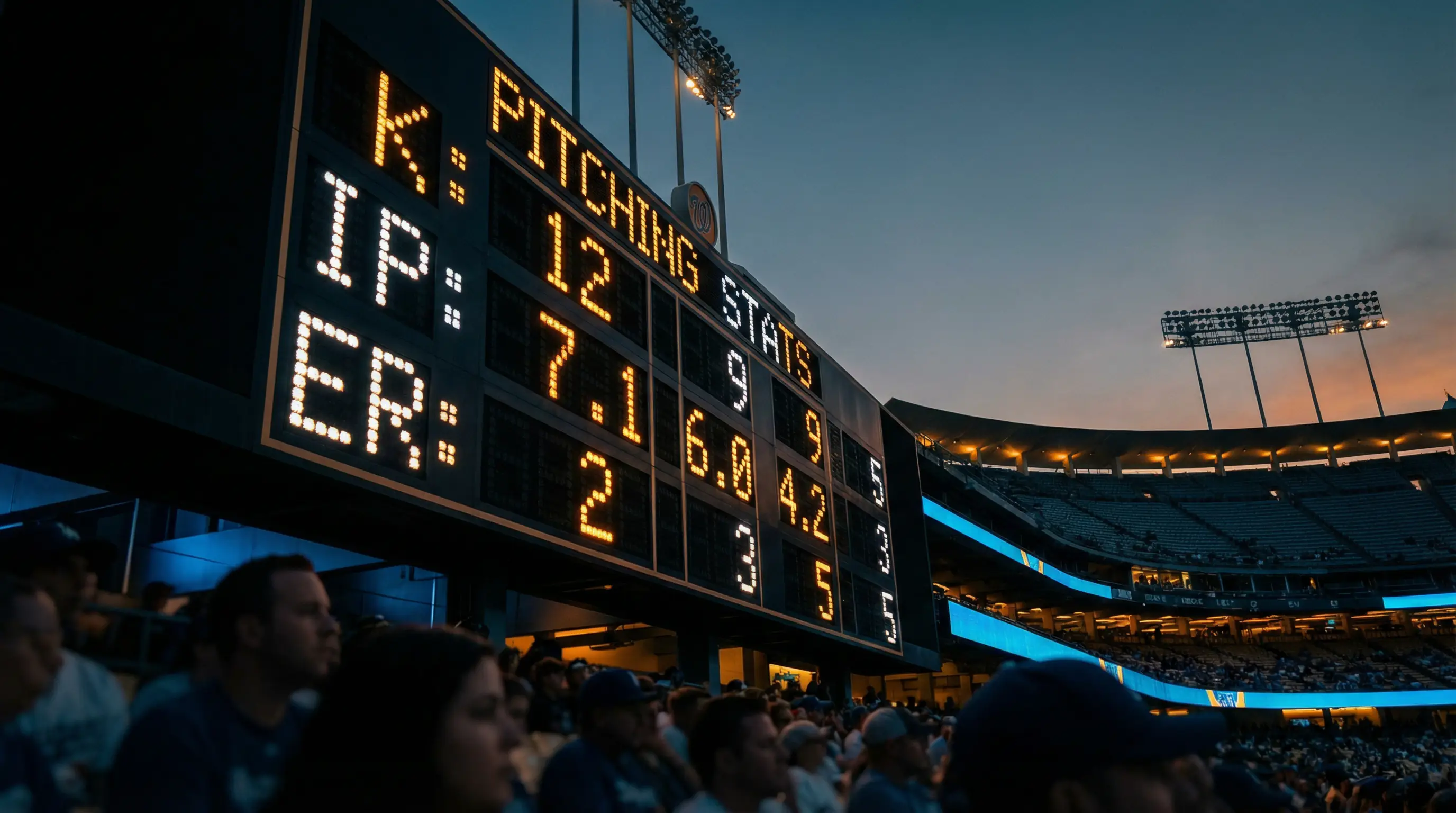
A pitcher's ERA tells you what happened. FIP — Fielding Independent Pitching — tells you what the pitcher actually controlled. That distinction cost me real money before I understood it, because I was pricing pitchers based on outcomes that included lucky bloops, defensive errors and outfield positioning that had nothing to do with the arm on the mound.
FIP strips a pitcher's record down to three things he controls entirely: strikeouts, walks and home runs allowed. Research published in peer-reviewed sports medicine journals has confirmed that FIP is a better predictor of future ERA than current ERA itself. For betting purposes, that means a pitcher with a 4.20 ERA but a 3.10 FIP is almost certainly undervalued by the market.
Andrew Rhodes, CEO of the UK Gambling Commission, noted in January 2025 that operators are seeing "a widening out of the sports offering in particular, with sports beyond the traditional horseracing and football growing in use." American sports — baseball included — are part of that expansion. But the UK bettors moving into MLB are walking into a sport where the analytical infrastructure is decades ahead of football. Sabermetrics has been mainstream in baseball front offices since the early 2000s. The data is public, free and granular enough to build genuine betting models around.
Beyond FIP, metrics like wOBA (weighted On-Base Average) assign run values to every offensive event — a home run is worth more than a single, which is worth more than a walk. Traditional batting average treats all hits equally, which is absurd if you are trying to predict run scoring. For totals betting, wOBA is a sharper input than any conventional stat.
xERA (Expected Earned Run Average) — uses batted-ball data (exit velocity, launch angle) to estimate what a pitcher's ERA "should" be based on quality of contact allowed. A pitcher whose actual ERA is much higher than his xERA is likely due for improvement, making him a value target.
The full breakdown of which sabermetric stats matter most for which bet types — and where to find them for free — lives in the dedicated sabermetrics betting edge guide. Here, the point is simpler: if you are evaluating MLB games using ERA, batting average and win-loss records, you are using the wrong inputs. The market prices off better data. You need to match it — or, better yet, find the spots where the market has not caught up to the data yet.
Bankroll Management for a 162-Game Season
Here is a confession that might save you money: in my second year of MLB betting, I went 22-8 in June and then blew a third of my bankroll in July by increasing my stakes to chase the momentum. The wins felt like skill. The losses felt like bad luck. In reality, I had abandoned the one discipline that makes MLB betting sustainable — flat staking through the grind.
A 162-game season is not a sprint and not even a marathon. It is a daily grind where variance can bury you for weeks at a time. A 55% win-rate bettor — which is strong — will regularly endure losing streaks of eight or nine games. If your unit size balloons during hot stretches and does not contract during cold ones, you are letting emotion override mathematics.
Bankroll Ground Rules for MLB
- Set a bankroll at the start of the season that you can afford to lose entirely. Not partly. Entirely.
- Define one unit as 1-2% of that bankroll. At a 500-pound bankroll, one unit is 5-10 pounds.
- Bet flat: every standard play is one unit. Strong conviction plays get a maximum of two units.
- Cap daily exposure at 3-5 units regardless of how many games look appealing.
- Review your record weekly, not daily. Daily results are noise.
Flat staking vs variable staking over 500 bets at 54% accuracy
Flat: 500 bets at 1 unit each, average decimal odds 1.91. Wins: 270. Return: 270 x 1.91 = 515.7 units. Profit: 15.7 units (3.1% ROI).
Variable: same 500 bets, but stakes range from 1 to 5 units based on "confidence." One bad 5-unit losing run in week 6 wipes out four weeks of steady profit. Final ROI typically drops below flat staking even when the bigger bets hit at the same rate — because they rarely do.
The maths is clear. Flat staking protects you from yourself.
The Kelly Criterion — a formula that sizes bets based on your estimated edge — works in theory but demands accuracy in your probability estimates that most bettors cannot provide. I use a fractional Kelly (quarter-Kelly) as a ceiling for my strongest plays and flat-stake everything else. The full mechanics, seasonal adjustments from April through October, and a practical record-keeping system are covered in the bankroll management guide.
MLB Betting in the UK: Bookmakers, Regulation and Access
The UK gambling market is enormous — and almost entirely football-focused. Gross gambling yield hit a record of 16.8 billion pounds in the 2024-25 financial year, with sports betting alone generating 2.48 billion pounds annually as the largest single segment. About 10% of the UK adult population actively bets on sport online, and roughly 290 million online bets land on real sporting events every single month. Football dominates that handle, claiming over a billion pounds in GGY by itself. Baseball's share is a rounding error — for now.
10%
Share of UK adults who actively bet on sport online — roughly 5.5 million people.
290 Million
Online sports bets placed monthly in the UK across all sports.
2x
The growth in MLB's UK fanbase since 2019, per Commissioner Rob Manfred's own figures.

Chris Marinak, MLB's Chief Operations and Strategy Officer, stated in 2024 that the league has "clearly identified the U.K. as a priority market and an area that we plan to emphasis for international growth of Major League Baseball." That is not lip service. The London Series, expanded broadcast deals with TNT Sports and previously BBC Sport, and a tripling of MLB Europe's social media following to over 452,000 since 2019 are all tangible investments in making baseball visible to British audiences.
For UK bettors, access to MLB markets is better than most assume. UKGC-licensed bookmakers routinely cover moneyline, run line, totals and selected player props for every MLB game during the season. The depth of coverage varies — some operators offer full alternate run lines and same game parlay builders, while others stick to the three core markets. The key filter is the UKGC licence itself: only bet with operators licensed by the Gambling Commission, which ensures regulatory oversight, dispute resolution and responsible gambling tools.
The practical reality for UK punters entering MLB betting is encouraging. The sport is growing in Britain, the broadcast infrastructure exists, and the bookmaker coverage is functional if not yet as deep as football. The question is not whether you can bet on MLB from the UK — it is whether you are willing to do the work that turns access into edge. The full landscape, including how to evaluate which bookmakers offer the deepest MLB markets, sits in the dedicated baseball betting UK guide.
The London Series Effect: How Live MLB Reached British Fans
I was at London Stadium for the 2024 London Series. Mets versus Phillies. 108,956 people across two games, the atmosphere somewhere between a cricket test match and an NFL tailgate, and roughly 71% of the crowd were British residents — not American expats. That number stuck with me because it demolished the assumption that baseball in Britain is purely an imported novelty for homesick Americans.
MLB merchandise sales in the UK jumped 43% year-on-year after the 2023 London Series. Social media followers for MLB Europe grew by 133% in a single year. The London Series is not just a game — it is a marketing engine that converts casual curiosity into genuine fandom.
Interest in baseball among UK sports fans climbed from 4% in 2019 to 5.9% by 2023 — a nearly 50% increase in four years. That growth trajectory matters for bettors because it means more liquidity in UK MLB markets, more bookmaker attention to pricing accuracy, and ultimately deeper market coverage. The London Series brought live MLB to British soil for the first time in 2019, and the league has returned every year since because the economics work: the 2024 series generated an estimated $67 million in economic impact for London alone.
For UK bettors, the London Series also creates a unique betting angle. These games are played at a neutral venue with an unfamiliar surface, jet-lagged players and an atmosphere neither team has experienced before. That disruption introduces pricing inefficiencies that do not exist in a normal Tuesday night game at Dodger Stadium.
Scheduling Reality: BST and East Coast Start Times
There is no point pretending this is not a factor. During British Summer Time, a 7:05 PM East Coast start translates to 12:05 AM in London. West Coast games starting at 10:10 PM Eastern become 3:10 AM BST. If you plan to watch every game you bet on live, you will not sleep from April to October.
The practical compromise: focus your live betting on day games (which start around 5:00-6:00 PM BST) and weekend afternoon slates. For night games, place pre-game bets based on your research and check results in the morning. The data-driven approach I advocate throughout this guide does not require watching every pitch — it requires doing the analysis before first pitch.
I structure my MLB betting week around three blocks. Weekday afternoons (BST) catch the early-start games, usually getaway-day matchups where teams are travelling the next day. Saturday and Sunday afternoons deliver full slates starting from early evening BST. And I place pre-game bets on night games before 11 PM, reviewing the results and line movements the next morning over coffee. That rhythm has sustained me for years without sacrificing sleep or sanity.
One underappreciated benefit of the time zone gap: by the time UK bookmakers update their MLB lines in the morning, American sharp money has already moved the markets overnight. Reading that movement — comparing the opening line from the previous evening to the morning line on your UK platform — gives you a free look at where informed money went. It is not a system, but it is a useful signal.
The Pre-Bet Checklist: A Step-by-Step Workflow
Every morning during the MLB season, before I open a single betting slip, I run through the same checklist. It takes about 20 minutes. It has saved me from more bad bets than any strategy or metric ever has, because the most expensive mistakes in baseball betting are not analytical failures — they are skipped steps.
Daily Pre-Bet Workflow
- Confirm starting pitchers for every game on today's slate. If a pitcher is listed as "probable" rather than confirmed, flag the game and recheck before placing any bet.
- Check overnight line movement. Compare the lines on your UK bookmaker to the American closing lines from the previous session. Significant moves signal sharp action.
- Review weather for outdoor stadiums. Wind direction and speed at ballparks like Wrigley Field, Coors Field and the stadiums in Texas and Kansas City can materially shift totals value.
- Scan bullpen usage from the previous 1-3 days. A team that used their top relievers for 50+ pitches yesterday will lean on weaker arms tonight — that affects late-inning totals and live betting.
- Identify 2-4 games that align with your strategies. Not 8. Not 12. Two to four. Discipline on game selection is bankroll management in disguise.
- Set your stakes before opening the betting slip. Decide how many units each game gets based on your pre-existing rules, not on how you feel about the matchup in the moment.
- Place the bets. Then close the app. Revisiting your slip to add legs or parlays is how disciplined plans become expensive afternoons.

With the workflow in place, let me address the questions I hear most often from UK bettors who are either just starting with MLB or looking to sharpen their approach.
Frequently Asked Questions
How do American odds work, and how do I convert them to decimal?
American odds use a baseline of 100. Negative numbers (like -150) tell you how much you need to stake to profit 100 units — so -150 means stake 150 to profit 100. Positive numbers (like +130) tell you how much you profit on a 100-unit stake — so +130 means stake 100 to profit 130. To convert negative American odds to decimal, divide 100 by the absolute value and add 1. For -150: (100/150) + 1 = 1.67. To convert positive odds, divide by 100 and add 1. For +130: (130/100) + 1 = 2.30. Most UK bookmakers display decimal by default, but you will encounter American format constantly when reading US-based analysis and line tracking tools.
What is the run line in MLB betting and how does it differ from a point spread?
The run line is baseball's version of the spread, fixed at -1.5 for the favourite and +1.5 for the underdog. Unlike football's point spread, which varies with the perceived gap between teams (3, 7, 10 points), the MLB run line is almost always 1.5 runs — the price adjusts instead. Backing -1.5 means your team needs to win by 2 or more runs. Backing +1.5 means the underdog can lose by a single run and your bet still pays. With roughly 30% of MLB games decided by exactly one run, the run line is riskier for favourites than it appears at first glance.
How important is the starting pitcher when betting on MLB games?
The starting pitcher is the single largest factor in MLB moneyline pricing. A team's odds can shift by 30 to 50 cents (in American format) depending on which pitcher takes the mound. An ace at -180 becomes a mid-rotation arm at -120 for the same team in the same ballpark. That is because the starter typically pitches five to seven innings — controlling the majority of the game's outcome. For bettors, this means confirming the starting pitcher before every bet is non-negotiable. A late scratch changes everything.
What are the best MLB betting strategies for beginners?
Start with the moneyline. It is the simplest market — pick the winner, no spread involved. From there, focus on three principles: back home underdogs selectively (they win nearly 46% of games), avoid heavy favourites at -200 or steeper (the break-even rate is too demanding), and always check the starting pitcher matchup before committing to a bet. Resist the urge to bet on every game. Two or three well-researched bets per day will teach you more and cost you less than scattering eight bets across the slate. And keep a flat stake — one unit per bet until you have 200+ bets of tracked data to evaluate your edge.
Can UK bettors legally bet on MLB, and which bookmakers offer baseball markets?
Yes, UK bettors can legally bet on MLB through any bookmaker holding a valid UKGC licence. Most major UK-licensed operators cover MLB moneyline, run line and totals for every regular-season and postseason game. Coverage of player props and same game parlays varies by operator — some offer deep prop menus, others stick to the basics. All bets are settled under UKGC regulations, which means you have access to dispute resolution, responsible gambling tools and deposit limits. The key is to verify that your bookmaker is UKGC-licensed and that their MLB market depth matches the bet types you want to use.
How do weather and ballpark factors affect MLB totals?
Weather and ballpark dimensions are material factors in MLB totals betting. Wind blowing out at Wrigley Field adds roughly 1-2 runs to the expected total. Coors Field in Denver, at 5,280 feet of altitude, inflates scoring because the thin air lets fly balls carry further. Temperature matters too — balls travel further in heat and die faster in cold. Humidity reduces air density and can push totals slightly higher. Conversely, a dense marine layer at a coastal park like Oracle in San Francisco suppresses offence. Checking the forecast for outdoor stadiums is not optional for totals bettors — it is a core part of the pre-bet workflow.
What makes MLB betting structurally different from Premier League football betting?
Three structural differences matter most. First, MLB has no draw — every game produces a winner, which simplifies moneyline pricing and eliminates the 1X2 market entirely. Second, the 162-game season produces a sample size that the Premier League's 38-match calendar cannot match. In football, one red card or missed penalty can define a month of results. In baseball, a bad week is statistical noise. Third, MLB's data infrastructure — sabermetrics — is decades more advanced than football analytics. Public metrics like FIP, wOBA and exit velocity give bettors free access to predictive data that outperforms traditional stats. Football's xG and xA metrics are catching up, but baseball's analytical ecosystem is still deeper, older and more widely adopted.
Created by the "DiamondEdge" editorial team.
